
Deciding where to spend your retirement years is one of the most important choices you will ever make. For years, Indian seniors planning their retirement faced real worries with property purchases. Delayed flat possession, unexpected maintenance price hikes, confusing leasehold terms and builders shifting funds left many elderly buyers stressed about their hard-earned money. Senior citizens deserve complete legal safety, transparent paperwork and total respect when buying their retirement home.
This is why understanding RERA legal rights and rules for senior living in India is essential for every family. Brought in through the Real Estate (Regulation and Development) Act 2016, RERA gave homebuyers clear legal protection. Combined with the Senior Citizen Housing guidelines issued by the Ministry of Housing and Urban Affairs (MoHUA), RERA sets clear rules for developers. Whether you are buying an independent villa or an apartment with assisted care, knowing your legal rights protects your savings and your family peace of mind.
What Are RERA Regulations for Senior Living in India?
RERA regulations require all commercial senior living projects to register with state real estate authorities, keep 70% of buyer funds in separate escrow accounts, provide 100% freehold registry deeds, follow promised completion dates and build senior-friendly facilities without hidden costs.
Before RERA came into force, retirement projects in India had very little government oversight. Builders often advertised retirement villages but used standard residential contracts that offered no elder-specific safety features. Today, any senior housing project with more than 500 square metres of land or eight apartments must register with the State Real Estate Regulatory Authority before booking or selling an apartment for elderly parents or an independent villa.
When seniors evaluate senior living destinations across India, RERA registration is a legally binding promise. The authority checks the land title, town planning approvals, layout plans, environmental permissions and construction schedule. Once registered, every single facility promised in the brochure, such as on-site medical clinics, wheelchair ramps and emergency call buttons, becomes a legal obligation for the builder.
State RERA portals also make project details public. You and your children can easily check quarterly building progress, bank escrow certificates, legal approvals and verified possession dates online from your phone or laptop before paying any token amount.
Key RERA Safeguards Protecting Senior Citizens
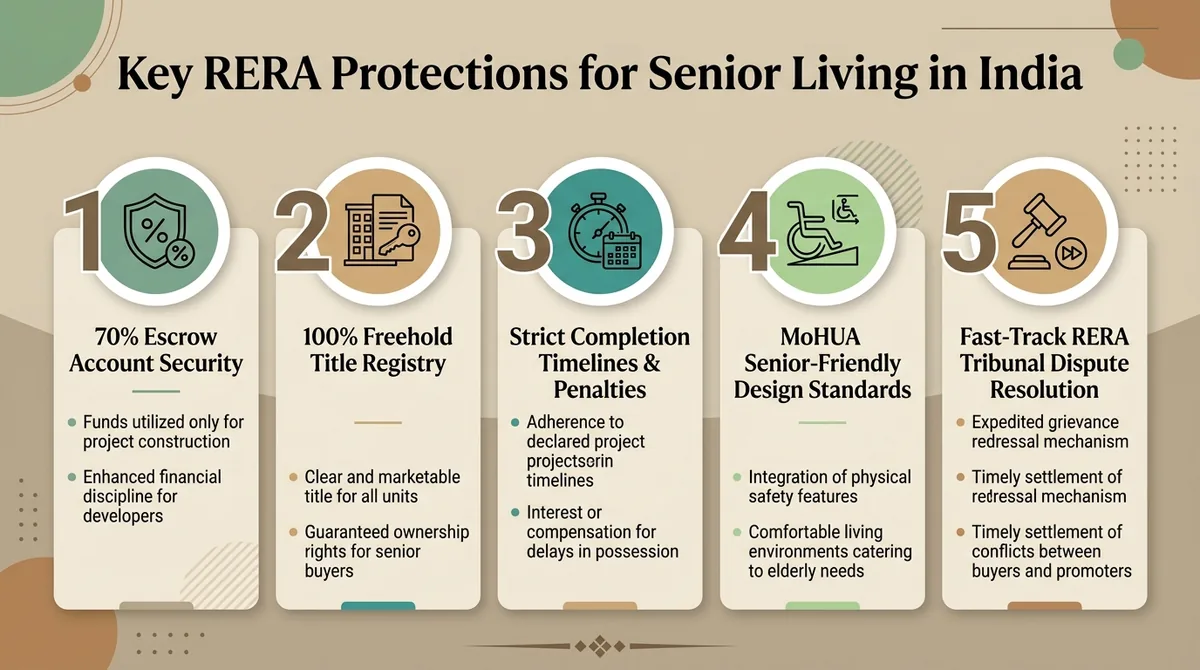
RERA protects senior homebuyers through five key rules: keeping 70% of project money in bank escrow accounts, offering a 5-year structural defect warranty, paying penalties for construction delays, charging only for usable carpet area and resolving disputes quickly through RERA tribunals.
Buying a retirement home usually means investing your life savings, provident fund, gratuity and pension. When comparing the pros and cons of retirement homes, RERA protects senior buyers through strict rules that every developer must follow:
- 70% Bank Escrow Account Protection: Builders must deposit 70% of all money collected from buyers into a dedicated project bank account. Money can only be withdrawn step-by-step as construction progresses, verified by an engineer, an architect and a chartered accountant. This stops builders from using your senior housing money on other projects.
- Pricing on Usable Carpet Area Only: In older projects, confusing terms like super built-up area increased prices by 25% to 35% without giving extra room. Under RERA, all senior apartments must be sold strictly on actual usable carpet area inside your walls.
- 5-Year Structural Defect Warranty: If any structural crack, construction flaw or plumbing defect appears within 5 years of possession, the builder must repair it free of cost within 30 days.
- Clear Possession Timelines and Delay Interest: If a builder misses the promised handover date, senior buyers can claim a full refund with interest or receive monthly interest compensation until possession is delivered.
- Quick Dispute Resolution: Senior citizens do not need to wait years in civil courts. State RERA authorities and tribunals are instructed to settle buyer complaints within 60 days.
When selecting your retirement home, checking developer background is just as important as checking the dining and medical setup. Choosing a community that values transparency and developer credibility ensures your retirement life stays relaxed and worry-free.
Looking for 100% RERA-Approved Senior Living?
URJA by CHL holds verified MP RERA Registrations (P-MHW-25-5710 and P-IND-25-5919), offering freehold ownership, escrow security and hospital-backed healthcare.
Discover URJA By CHLFreehold Title vs. Leasehold Models: Understanding Your Ownership Rights
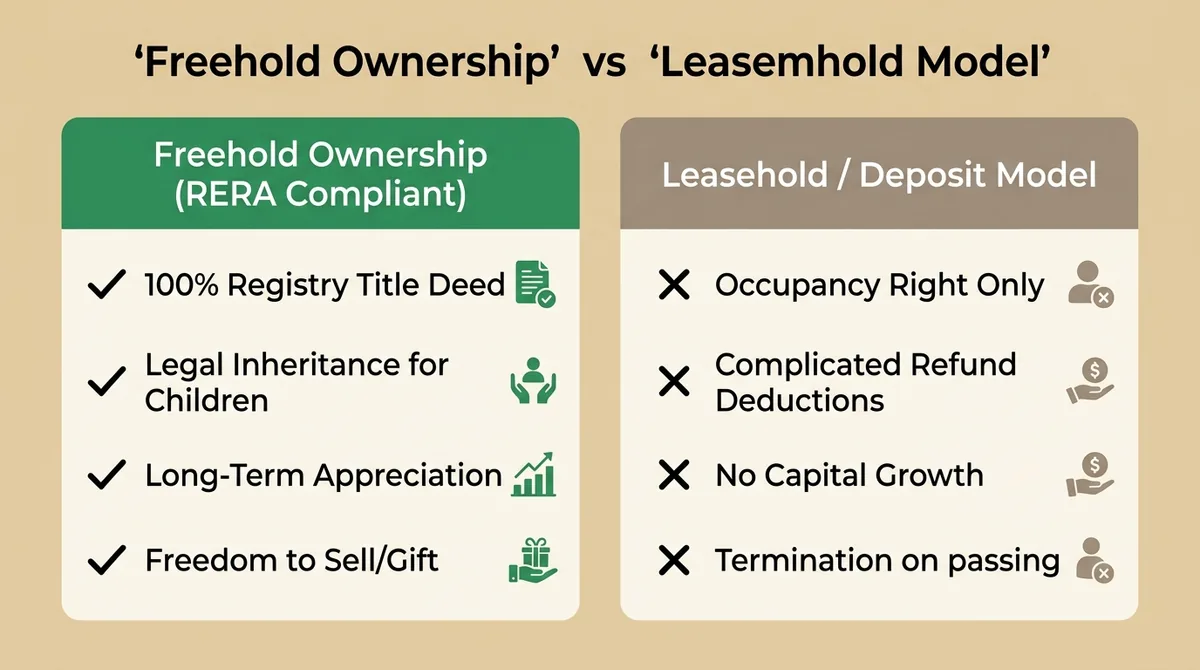
Senior living in India offers two models: freehold registry and leasehold. Freehold homes give you permanent ownership, full property value growth and simple inheritance for children. Leasehold models give only living rights, with deductions on deposit refunds when exiting.
A key decision when planning senior living in senior citizen gated communities in Indore and across India is choosing between a freehold ownership home and a leasehold or rental deposit model. Many families sign agreements without realizing how the property papers affect their family wealth and property inheritance.
In a freehold project, you get a registered sale deed at the local sub-registrar office. You are the legal owner of the apartment and your share of the land. The property is your family asset. You can take a bank loan, pass it down in your Will to your children, gift it or sell it at market prices anytime.
In leasehold or deposit models, seniors pay a large upfront deposit for occupancy rights, but the builder keeps the title deed. If the resident passes away or needs to move, getting the deposit back often involves heavy deductions for refurbishment and long waiting periods until another senior takes over the unit.
Detailed Comparison: Freehold Registry vs. Leasehold Senior Housing
| Legal and Financial Feature | 100% Freehold Title (RERA Registered) | Leasehold / Deposit Model |
|---|---|---|
| Property Ownership Status | Registered Sale Deed in buyer name with undivided land share. | Living agreement or long lease only; no land ownership. |
| Inheritance and Succession | Passes directly to children or legal heirs through Will or succession law. | Agreement ends on passing; children cannot automatically live there unless eligible. |
| Property Value Appreciation | 100% of real estate market price rise stays with the family. | Zero price appreciation; refund is limited to deposit amount minus deductions. |
| Resale and Exit Freedom | Owner or family can sell to eligible senior buyers at market rates. | Exit depends on operator finding a replacement; deductions of 10% to 25%. |
| RERA Escrow and Title Security | Protected by 70% escrow discipline and verified land title. | Private commercial contract with limited RERA ownership protection. |
| Bank Loan and Mortgage Options | Eligible for standard home loans and reverse mortgages from top banks. | Traditional bank home loans not available for lease deposits. |
For Indian families, a home is both an emotional haven and a strong family asset. Freehold senior living gives you professional care while keeping your wealth intact. To see how monthly running costs work alongside property purchase, check our simple guide on the cost of retirement homes in India.
MoHUA Model Guidelines for Senior Citizen Housing Infrastructure
The Ministry of Housing and Urban Affairs (MoHUA) guidelines mandate practical senior-friendly features, including wide step-free corridors, anti-skid bathroom tiles, emergency pull cords, rounded wall edges, stretcher-sized lifts and 24/7 on-campus medical care.
RERA rules for senior communities cover building safety and practical design alongside financial safety and comprehensive emergency healthcare infrastructure. The Ministry of Housing and Urban Affairs published model guidelines so that elderly residents can walk, shower and live without fear of slipping or falling.
When you visit any senior living campus, check that these essential safety features are present in the approved building plans:
- Step-Free Walkways: Continuous flat pathways without steps. Any level change must have gentle ramps with sturdy handrails on both sides.
- Senior-Safe Bathrooms: Anti-skid vitrified flooring with high wet grip, strong stainless steel grab bars near the commode and shower, outward-opening doors and emergency pull cords connected to the nurses desk.
- Stretcher-Friendly Elevators: Every residential block must have at least one large lift that fits a medical stretcher, fitted with automatic rescue devices during power cuts, voice announcements and low buttons reachable from a wheelchair.
- Bright Lighting and Clear Switches: Glare-free warm lighting in all common areas, large rocker light switches at convenient waist height and clean hallway acoustics to avoid confusion.
- On-Site Healthcare Facilities: Dedicated rooms for primary medical checkups, emergency care, 24/7 nursing staff and dedicated parking for an on-campus ambulance.
Communities with these safety designs help seniors stay active and independent without depending on family for daily movement. Read our detailed guide on senior-friendly design features in retirement homes to see how thoughtful planning prevents accidents.
Inheritance, Nomination and Resale Freedom in Senior Communities
Under Indian property law, a freehold retirement home passes directly to your nominated heirs or children. Heirs can live in the property if they meet the community age rules, rent it out to other seniors or sell it freely on the open market.
A common question senior parents and their NRI children exploring senior living homes for NRIs ask is: What happens to your senior living property after your lifetime? In a RERA-compliant freehold project, the legal answer is simple and clear.
Since the home has a registered freehold registry, it is governed by Indian succession laws. You can write a Will naming your spouse, children or grandchildren as legal owners. You can also file a nomination form with the community society or Resident Welfare Association.
Your legal heirs have three straightforward choices:
- Living in the Home: If your children or heirs are of eligible senior age (usually 55 or 60 years), they can move into the home and use all club and healthcare facilities.
- Renting to Senior Tenants: If your children are younger or working in other cities or abroad, they can rent the apartment to senior tenants. With high demand for managed senior homes, this earns steady monthly rent while property value grows.
- Selling on the Open Market: Your family can sell the apartment to any buyer who meets the senior community guidelines, without facing unfair transfer fees from the developer.
This clarity gives peace of mind to NRI children who want their parents to live comfortably in India with full medical safety. For more details on family care options, read our guide on why NRIs choose managed senior living in India.
Have Questions About RERA Rights or Campus Plans?
Speak with our advisors to review project registry deeds, RERA approvals and customized wellness plans for your retirement.
WhatsApp Our Legal AdvisorsHow to Verify RERA Registration Before Buying a Senior Living Unit
To verify a senior living project, visit your state RERA website, search the builder registration number, check sanctioned building maps, verify the bank escrow account details and confirm clear maintenance terms in the sale agreement.
Doing a quick paperwork check before paying booking money protects your savings. Here is a simple step-by-step checklist to follow:
- Step 1: Check the State RERA Website: Visit the official state portal (such as the Madhya Pradesh RERA Portal for Indore projects). Enter the project registration number and check that the approval is active.
- Step 2: Check Sanctioned Maps and Layouts: Confirm that the floor plans, open green spaces and club amenities on the RERA website match what the sales team showed you.
- Step 3: Review the Agreement for Sale: Check that the agreement follows the standard RERA format, clearly stating the exact carpet area, construction milestone payment dates and possession timeline.
- Step 4: Check Maintenance and Dining Charges: Review the maintenance agreement carefully. Basic campus maintenance should be clearly separated from optional daily meal plans and personal medical packages to avoid unexpected fee increases.
- Step 5: Verify Developer Background: Look for developers with established experience in healthcare and real estate. For example, URJA by CHL holds verified MP RERA Registrations P-MHW-25-5710 and P-IND-25-5919, backed by the 25-year medical legacy of CHL Hospitals in Central India. Learn more on our about CHL Urja page.
Taking these simple steps ensures your move to a retirement community is safe, legal and happy. For practical tips on selecting communities, read our guide on how to choose the right senior living homes in India.
Frequently Asked Questions
1. What legal protections, transparency rules, and freehold ownership rights do RERA registered senior living projects offer in India?
RERA registered senior living communities protect buyers by keeping 70% of project funds in bank escrow accounts, providing 100% freehold registry title deeds, setting binding completion deadlines with financial delay penalties and settling complaints quickly through specialised real estate tribunals within 60 days.
2. Is buying a freehold senior living home safer than entering a leasehold or deposit agreement?
Yes. A freehold senior living home gives you full legal registry ownership with an undivided share of land. You keep 100% of property appreciation, can pass the home to your children in a Will and can sell or rent the home without heavy exit deductions common in leasehold deposit models.
3. Can children or legal heirs inherit a RERA-registered senior living apartment?
Yes. Under Indian succession laws, legal heirs inherit full ownership of a freehold retirement property. If the heirs meet the community age rules, they can live in the home. They can also rent the flat to senior tenants or sell it on the open market at prevailing prices.
4. How does RERA regulate monthly maintenance and healthcare charges in retirement communities?
RERA requires builders to clearly explain all monthly maintenance costs in the registered sale agreement. Charges cannot be increased arbitrarily, and basic campus upkeep must be clearly separated from optional dining and medical plans.
5. How can I verify the official RERA registration details of URJA by CHL in Indore?
You can verify URJA by CHL directly on the official MP RERA web portal by searching registration numbers P-MHW-25-5710 and P-IND-25-5919. The portal shows approved layout maps, environmental clearances, quarterly building updates and promoter details.